 DailyDevotion.appDaily Devotion
Ask Bible AI: Christian Answer
Ask the question you actually have
One question, answered properly, with the passages it rests on. When you have a follow-up — and you will — the app answers that one too.

A closer look
Ask, read and keep going
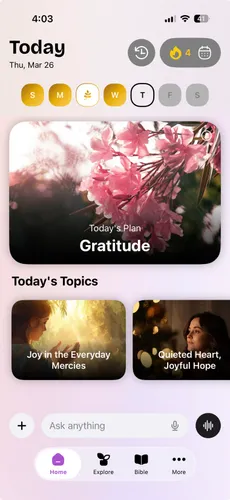
Today, at a glance
The verse, the plan and the topics waiting for you.
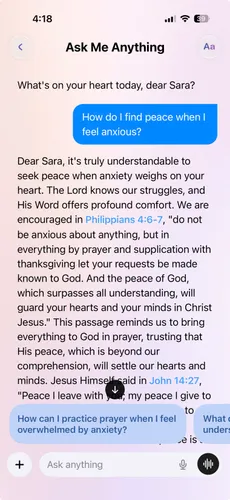
Ask anything
A question answered with the passages it rests on, not around them.
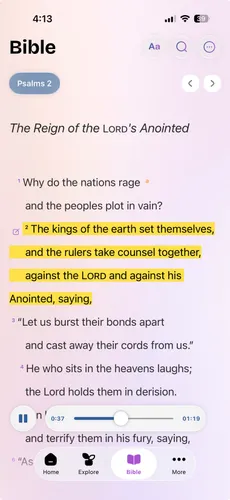
Read in KJV or ESV
The whole Bible, with highlighting and audio.
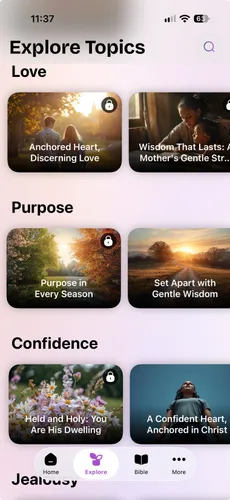
Follow a plan
Study paths grouped by what you are carrying.
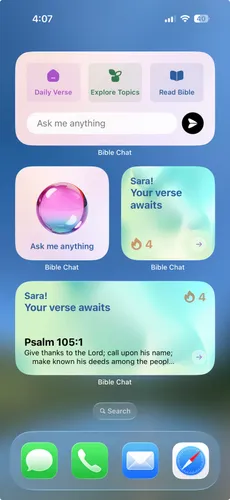
A verse on your Home Screen
Today’s verse where you already look.
Most questions about the Bible arrive in a particular order. First the verse someone quoted at you, then what it actually means, then the question underneath — whether it applies to you, and what you are supposed to do with it on a weekday.
The pages in this section take those one at a time. A verse meaning reads a single verse in its own setting: who wrote it, to whom, what was happening, and where it is most often misread. A prayer page gives you words for a specific weight and sets out the passages the prayer leans on, so you can see that it is not asking for something Scripture never offered.
Every quotation on these pages is the real King James or English Standard wording, checked word by word against the text before the page is published. The explanation around it is one careful reading rather than the last word, and the passage is always printed beside it so you can weigh it yourself. Where an explanation and the text seem to disagree, trust the text.
Ask Bible AI is the same idea with no page limit: type the question you have, in the words you would use with a friend, and get an answer from Scripture with every verse cited.
How to weigh an answer about the Bible
Whoever gives an answer, the same three checks apply. First, does it cite a passage, and does the passage say what the answer claims when you read the verses around it? A verse pulled out of its chapter can be made to say almost anything, and the surrounding lines are usually what settle it.
Second, does it separate what the text says from what it does not? The Bible is silent on a great many things people want to know, and an answer that is sure about everything has filled some of those silences with opinion. A good answer says where the text stops.
Third, does it agree with the rest of Scripture? Christians have long read the clearer passages as a guide to the harder ones. An answer that turns one difficult verse against many plain ones should be held loosely.
Asking a better question
The most useful questions are specific. “What does the Bible say about worry?” will get a survey. “What does Jesus mean in Matthew 6 when he says not to worry about tomorrow, when I have rent due on Friday?” gets an answer about your Friday. Say what prompted the question, name the verse if you have one, and ask the follow-up you actually want to know.
It also helps to ask the question underneath the first one. Behind “is it a sin to doubt?” there is usually “am I still a Christian if I am not sure?”, and that second question has better passages to answer it.
Where an answer should stop
Some questions belong with people who know you. Grief that will not lift, a marriage in trouble, a decision with real risk, thoughts of harming yourself: a page or an app can point you to the passages, but it cannot sit with you, and it should not pretend to. Take those to your pastor, a counsellor or a friend, and if you are in danger, to emergency help today.
An answer is one careful reading of the text, offered so you can read the text yourself. Treat it the way the Bereans treated Paul.
10 passages on asking, and on checking the answer
“Ask, and it will be given to you; seek, and you will find; knock, and it will be opened to you.
Matthew 7:7 ESVAsk, and it shall be given you; seek, and ye shall find; knock, and it shall be opened unto you:
Matthew 7:7 KJVThree verbs, each a step further than the one before: asking, then looking, then standing at a door. Nothing in the verse suggests the first question is the last one.
If any of you lacks wisdom, let him ask God, who gives generously to all without reproach, and it will be given him.
James 1:5 ESVIf any of you lack wisdom, let him ask of God, that giveth to all men liberally, and upbraideth not; and it shall be given him.
James 1:5 KJVThe one asked here is God, and the promise is that he does not scold the person asking. Whatever else you consult, this is the question to bring first, and the verse says there is no shame in bringing it.
Now these Jews were more noble than those in Thessalonica; they received the word with all eagerness, examining the Scriptures daily to see if these things were so.
Acts 17:11 ESVThese were more noble than those in Thessalonica, in that they received the word with all readiness of mind, and searched the scriptures daily, whether those things were so.
Acts 17:11 KJVThe teacher being checked was Paul. The people of Berea listened eagerly and then opened the Scriptures to see whether he was right, and Luke calls that noble rather than suspicious.
but test everything; hold fast what is good.
1 Thessalonians 5:21 ESVProve all things; hold fast that which is good.
1 Thessalonians 5:21 KJVTwo instructions in one line, and the order matters: test first, then keep what passes. It applies to a sermon, a book, a friend's advice and any answer on a screen.
The one who states his case first seems right, until the other comes and examines him.
Proverbs 18:17 ESVHe that is first in his own cause seemeth just; but his neighbour cometh and searcheth him.
Proverbs 18:17 KJVThe first answer you hear always sounds complete. This proverb is the reason to read the passage itself, and the verses around it, before deciding the matter is settled.
“The secret things belong to the LORD our God, but the things that are revealed belong to us and to our children forever, that we may do all the words of this law.
Deuteronomy 29:29 ESVThe secret things belong unto the LORD our God: but those things which are revealed belong unto us and to our children for ever, that we may do all the words of this law.
Deuteronomy 29:29 KJVSome questions have no answer in the text, and this verse says so plainly. An honest answer marks that line instead of filling the silence with a guess.
All Scripture is breathed out by God and profitable for teaching, for reproof, for correction, and for training in righteousness, that the man of God may be complete, equipped for every good work.
2 Timothy 3:16-17 ESVAll scripture is given by inspiration of God, and is profitable for doctrine, for reproof, for correction, for instruction in righteousness: That the man of God may be perfect, throughly furnished unto all good works.
2 Timothy 3:16-17 KJVThe list ends in work, not in information. An answer has done its job when it leaves you better equipped to do something, not only better informed.
The unfolding of your words gives light; it imparts understanding to the simple.
Psalm 119:130 ESVThe entrance of thy words giveth light; it giveth understanding unto the simple.
Psalm 119:130 KJVUnderstanding is promised to the simple, not to the expert. A question does not have to be clever to be worth asking, and the light comes from the words being opened, not from the person explaining them.
You search the Scriptures because you think that in them you have eternal life; and it is they that bear witness about me,
John 5:39 ESVSearch the scriptures; for in them ye think ye have eternal life: and they are they which testify of me.
John 5:39 KJVJesus speaks to people who searched the Scriptures carefully and still missed what they pointed to. Study is meant to lead somewhere beyond itself, which is a fair test of any answer too.
but in your hearts honor Christ the Lord as holy, always being prepared to make a defense to anyone who asks you for a reason for the hope that is in you; yet do it with gentleness and respect,
1 Peter 3:15 ESVBut sanctify the Lord God in your hearts: and be ready always to give an answer to every man that asketh you a reason of the hope that is in you with meekness and fear:
1 Peter 3:15 KJVQuestions run both ways. The answers you find are meant to be passed on one day, and the verse says how: gently, and with respect for the person asking.
Look at what these passages ask of the person with the question. Ask, and keep asking. Check what you are told against the text, even when the teacher is an apostle. Test it, and keep only what holds. Leave alone what Scripture leaves unsaid.
None of that changes depending on who answers, whether a pastor, a commentary, a friend or an app. The answer is only as good as the passages it rests on, which is why every answer here prints them beside it.
Inside Ask Bible AI
- Ask anythingQuestions about a verse, about doctrine or about an ordinary Tuesday, answered from the Bible with the references beside them, so you can read every cited verse for yourself.
- Every verse in KJV or ESVThe passages an answer rests on are quoted in full, in either translation. Where the Bible does not say, the answer says so rather than filling the gap.
- Follow up as long as you likeA page answers one question. The app keeps going: ask the next one in your own words, and keep prayers, answers and reflections in one private Prayer Journey.
- Ask from your home screenAn Ask widget takes your question straight to an answer without opening a menu, and a Verse of the Day widget keeps today's verse beside it.
- Devotionals and study by seasonA short daily devotional written by people, and guided paths for the season you are in — a healing heart, work and calling, motherhood and more.
Verse meanings
- Romans 8:28 MeaningAmong the most quoted verses in the New Testament, and among the most misused at funerals. Here is what Paul actually claims.
- Jeremiah 29:11 MeaningThe verse on more graduation cards than any other, written to people who were told to unpack and settle in.
- Psalm 34:18 MeaningA verse for the middle of it, not the end of it.
Prayers
- Prayer for StrengthMost prayers for strength ask to be made unbreakable. The passages underneath them tend to offer something else, and it is more useful.
- Prayer for AnxietyMost prayers about anxiety ask for the feeling to stop. The passages underneath them more often offer somewhere to put it.
- Prayer for ForgivenessMost prayers for forgiveness end up trying to prove how sorry they are. The passages underneath them put the weight somewhere else.
Good to know
Is the app free?
Yes. Downloading it is free, and so is the part most people come for — asking a question, reading the Bible, following a plan. There are paid extras on top of that.
Which Bible translations are included?
The King James Version and the English Standard Version. You can read either, and switch between them on any passage. This site quotes the same two.
What can I ask it?
Anything you would ask someone who knew the passage well. What a verse means. Who it was written to. Why one translation words it differently from another. Where to start reading when you have no idea.
The questions people actually ask are rarely tidy ones. Those are fine too.
Does it get the Bible right?
The verse itself is the real King James or English Standard wording, word for word.
The explanation around it is a different matter. It is one careful reading rather than the last word, and it shows you the passage underneath so you can weigh it yourself. Where an answer and the text seem to disagree, trust the text.
Can I keep a verse on my Home Screen?
Yes. There are widgets for the daily verse, and one that opens straight into asking a question.
Scripture quotations marked KJV are from the King James Version, which is in the public domain. Scripture quotations marked ESV are from the ESV® Bible (The Holy Bible, English Standard Version®), © 2001 by Crossway, a publishing ministry of Good News Publishers. Used by permission. All rights reserved.