 DailyDevotion.appDaily Devotion
Bible Study for Women App
Bible studies for women
Over 400 human-written Bible studies by topic, a daily verse and devotion, guided plans and a full Bible reader — and twelve passages on what studying Scripture actually involves.

A closer look
A study shelf that fits in your hand
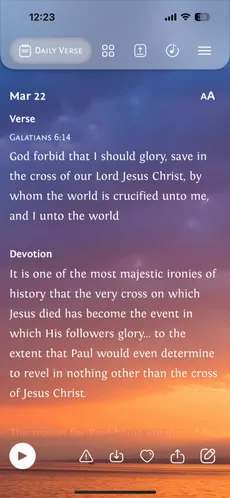
Verse of the Day
Daily Scripture
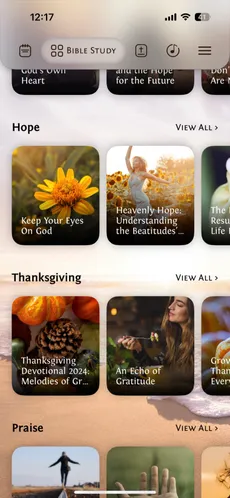
Topical studies
400+ topics

Explore plans
Featured & new

Study plans
Guided journeys
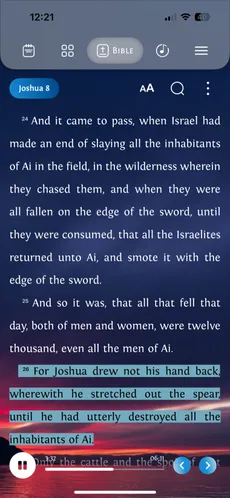
Bible reader
KJV & ESV · Notes · Audio
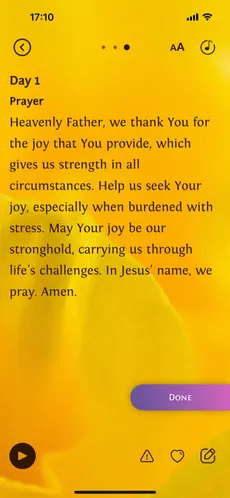
Guided prayers
Written for you
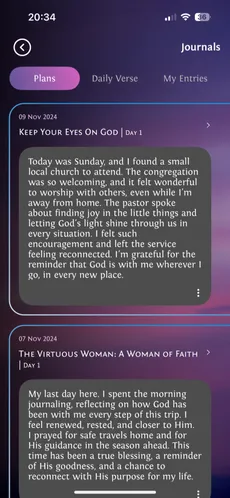
Faith journals
Reflect & pray
Study, in the sense these passages describe, is slow. It involves checking, digging, asking to see what you have been missing, and being corrected by someone who knows the text better than you do.
That is not the tone of most material marketed to women, which tends toward the encouraging verse and the reassuring paraphrase. The passages below are the other thing — what Scripture says about learning it, and the women the New Testament happens to show in the middle of that work.
Each is given in full in both translations, with a short note on what it is doing in its own book.
12 passages on studying Scripture
So Ezra the priest brought the Law before the assembly, both men and women and all who could understand what they heard, on the first day of the seventh month. And he read from it facing the square before the Water Gate from early morning until midday, in the presence of the men and the women and those who could understand. And the ears of all the people were attentive to the Book of the Law.
Nehemiah 8:2-3 ESVAnd Ezra the priest brought the law before the congregation both of men and women, and all that could hear with understanding, upon the first day of the seventh month. And he read therein before the street that was before the water gate from the morning until midday, before the men and the women, and those that could understand; and the ears of all the people were attentive unto the book of the law.
Nehemiah 8:2-3 KJVEzra reads the law to the assembly, and the account is careful about who is standing there: men, women, and everyone able to understand what was read. The detail is included deliberately, in a chapter about a people having the law read and explained to them after the return from exile.
Now as they went on their way, Jesus entered a village. And a woman named Martha welcomed him into her house. And she had a sister called Mary, who sat at the Lord's feet and listened to his teaching. But Martha was distracted with much serving. And she went up to him and said, “Lord, do you not care that my sister has left me to serve alone? Tell her then to help me.” But the Lord answered her, “Martha, Martha, you are anxious and troubled about many things, but one thing is necessary. Mary has chosen the good portion, which will not be taken away from her.”
Luke 10:38-42 ESVNow it came to pass, as they went, that he entered into a certain village: and a certain woman named Martha received him into her house. And she had a sister called Mary, which also sat at Jesus' feet, and heard his word. But Martha was cumbered about much serving, and came to him, and said, Lord, dost thou not care that my sister hath left me to serve alone? bid her therefore that she help me. And Jesus answered and said unto her, Martha, Martha, thou art careful and troubled about many things: But one thing is needful: and Mary hath chosen that good part, which shall not be taken away from her.
Luke 10:38-42 KJVMary is described as sitting at the Lord's feet, listening. Acts 22:3 uses the same picture for Paul's own training under Gamaliel, which suggests the phrase is describing a student rather than an admirer — and Jesus defends the choice.
Open my eyes, that I may behold wondrous things out of your law.
Psalm 119:18 ESVOpen thou mine eyes, that I may behold wondrous things out of thy law.
Psalm 119:18 KJVA prayer to have the eyes opened to see wonders in the law. It assumes something can be genuinely present in the text and still missed by the person reading it, which is a useful thing to admit before opening a Bible.
yes, if you call out for insight and raise your voice for understanding, if you seek it like silver and search for it as for hidden treasures, then you will understand the fear of the LORD and find the knowledge of God.
Proverbs 2:3-5 ESVYea, if thou criest after knowledge, and liftest up thy voice for understanding; If thou seekest her as silver, and searchest for her as for hid treasures; Then shalt thou understand the fear of the LORD, and find the knowledge of God.
Proverbs 2:3-5 KJVThe search is described in the language of digging — calling out, hunting for it the way you would hunt for buried silver. By the sentence's own logic the understanding follows the effort rather than arriving instead of it.
Now these Jews were more noble than those in Thessalonica; they received the word with all eagerness, examining the Scriptures daily to see if these things were so.
Acts 17:11 ESVThese were more noble than those in Thessalonica, in that they received the word with all readiness of mind, and searched the scriptures daily, whether those things were so.
Acts 17:11 KJVThe Bereans are commended for checking the Scriptures to see whether what Paul told them was actually so. The praise goes to the ones who verified the apostle, which is worth remembering about any teacher, including a good one.
He began to speak boldly in the synagogue, but when Priscilla and Aquila heard him, they took him aside and explained to him the way of God more accurately.
Acts 18:26 ESVAnd he began to speak boldly in the synagogue: whom when Aquila and Priscilla had heard, they took him unto them, and expounded unto him the way of God more perfectly.
Acts 18:26 KJVApollos is already an able speaker when Priscilla and Aquila take him aside and explain the way of God more accurately to him. Both are named as doing the explaining, and the one being corrected is a public teacher.
One who heard us was a woman named Lydia, from the city of Thyatira, a seller of purple goods, who was a worshiper of God. The Lord opened her heart to pay attention to what was said by Paul.
Acts 16:14 ESVAnd a certain woman named Lydia, a seller of purple, of the city of Thyatira, which worshipped God, heard us: whose heart the Lord opened, that she attended unto the things which were spoken of Paul.
Acts 16:14 KJVLydia is listening when the Lord opens her heart to pay attention to what Paul said. Attention is described here as something given to her — which puts the reader's own concentration in a different light than sheer effort does.
Many Samaritans from that town believed in him because of the woman's testimony, “He told me all that I ever did.”
John 4:39 ESVAnd many of the Samaritans of that city believed on him for the saying of the woman, which testified, He told me all that ever I did.
John 4:39 KJVMany in the town believe because of what the Samaritan woman told them about her conversation at the well. The same chapter has her discussing worship and living water with Jesus; the account presents her report as the thing that moved people.
Let a woman learn quietly with all submissiveness.
1 Timothy 2:11 ESVLet the woman learn in silence with all subjection.
1 Timothy 2:11 KJVThe verb Paul uses here is learn. What surrounds this sentence is among the most argued material in the letter, and readers land in very different places on it — but the disagreement is about the conditions, not about whether she learns.
Older women likewise are to be reverent in behavior, not slanderers or slaves to much wine. They are to teach what is good, and so train the young women to love their husbands and children, to be self-controlled, pure, working at home, kind, and submissive to their own husbands, that the word of God may not be reviled.
Titus 2:3-5 ESVThe aged women likewise, that they be in behaviour as becometh holiness, not false accusers, not given to much wine, teachers of good things; That they may teach the young women to be sober, to love their husbands, to love their children, To be discreet, chaste, keepers at home, good, obedient to their own husbands, that the word of God be not blasphemed.
Titus 2:3-5 KJVOlder women are told to teach what is good and to train the younger ones. How far the specific instruction list carries into other centuries is debated; that the teaching is assigned to women within the church is stated plainly.
I am reminded of your sincere faith, a faith that dwelt first in your grandmother Lois and your mother Eunice and now, I am sure, dwells in you as well.
2 Timothy 1:5 ESVWhen I call to remembrance the unfeigned faith that is in thee, which dwelt first in thy grandmother Lois, and thy mother Eunice; and I am persuaded that in thee also.
2 Timothy 1:5 KJVPaul names Lois and Eunice, Timothy's grandmother and mother, as where the faith he sees in Timothy lived before it lived in him. The letter also says Timothy has known the sacred writings since childhood, though it does not say who taught him.
All Scripture is breathed out by God and profitable for teaching, for reproof, for correction, and for training in righteousness, that the man of God may be complete, equipped for every good work.
2 Timothy 3:16-17 ESVAll scripture is given by inspiration of God, and is profitable for doctrine, for reproof, for correction, for instruction in righteousness: That the man of God may be perfect, throughly furnished unto all good works.
2 Timothy 3:16-17 KJVScripture is called profitable for teaching, reproof, correction and training — and the stated aim of all four is that the man of God may be complete, equipped for every good work. Read that way, the goal of study is what you are made able to do, not what you know.
There is not a separate Bible for women, and no passage here describes a smaller version of the work. What the New Testament does instead is show women doing it, usually in passing, usually without comment.
Mary sits down to listen and is defended for it. Priscilla takes an eloquent preacher aside and corrects his theology. Lydia is paying attention when her heart is opened. A woman in Samaria has a long argument about worship and then goes and tells a town. Nehemiah's chronicler stops to specify that the women were standing there for the reading.
The method passages are just as plain. Proverbs describes digging. Psalm 119 admits you can look straight at something and miss it. Acts 17 praises people for checking their teacher against the text. None of that is gendered, and none of it is quick.
If you have mostly been handed devotional verses about your worth, this is a different shelf — and 2 Timothy 3:17 says where it is meant to end up, which is not in knowing more but in being equipped to do something.
Inside Bible Study
- 400+ Bible studiesHuman-written studies organised by the seasons of a woman’s life — joy, rest, forgiveness, family, gratitude and many more.
- Verse of the DayA fresh verse and a short devotion each morning in the KJV and ESV, set against nature backgrounds.
- Guided study plansMulti-day journeys you move through a step at a time, rather than a feed to scroll, each day closing with a written prayer.
- Full Bible reader & journalsThe whole Bible in KJV and ESV with highlighting, notes, bookmarks and audio narration, and journals for prayers and reflections.
Bible verses
- Bible Verses About JoyWhy joy keeps turning up next to the hard part rather than instead of it.
- Bible Verses About RestWhy rest is commanded rather than earned, and what it is actually for.
- Bible Verses About ComfortWhat Scripture offers the grieving, and what it never says.
- Bible Verses for GuidanceWhy guidance in Scripture is a lamp, not a floodlight.
- Bible Verses About EncouragementWhat Scripture says to someone running low — and who it expects to say it.
- Bible Verses About Your WorthWhere Scripture puts your worth, and what it refuses to tie it to.
- Bible Verses About ForgivenessWhat forgiveness asks of you, and the one thing it does not.
- Bible Verses About FamilyWhat Scripture asks of a household — and how honest it is about hard ones.
- Bible Verses About GratitudeWhy thanks in Scripture is a practice, not a mood.
- Bible Verses for PraiseWhy so much praise in Scripture is commanded rather than spontaneous.
- Bible Verses for FaithfulnessWhat faithfulness claims — and who tends to be the one saying it.
- Bible Verses About BlessingWhy blessed is not another word for things going well.
- Bible Verses About GodWhat Scripture says God is like, from his own words and from the people who met him.
- Bible Verses for WomenThe passages most often handed to women, read in their own context.
Articles
- How to Study a Whole Book of the BibleA method for reading one book properly, and which one to start with.
- What to Do With a Passage You Cannot Make Sense OfWhy the confusing passages are a good sign, and how to work on them.
- Using a Study Plan Without It Becoming HomeworkWhy plans collapse in week three, and what to do about the missed days.
Good to know
Is the app free?
Yes. The Bible Study for Women App is free to download and free to use on iOS. There is no Android version.
How many Bible studies are there?
More than 400, with new plans added regularly. They are grouped into categories like relationships, family and the seasons a life actually moves through, so you can start where you are rather than at the beginning of a syllabus.
Which Bible translations are included?
Both the King James Version and the English Standard Version. The daily verse and the full in-app Bible reader are available in each, so you can read in the language you grew up with or the one that lands most clearly.
Who writes the studies?
Real people — not algorithms. Every study and devotion is written and edited by people of faith, for women of faith, which is why the words read like someone meant them rather than like something assembled.
How do the guided study plans work?
Each plan is a short sequence you move through a day at a time — a passage, a written reflection, and a prayer to close. Plans like “A Woman After God’s Own Heart” run five days and “Trust Transformed” runs seven, and you read them at your own pace rather than to a schedule, so a plan you set down three weeks ago is simply one you can pick up again.
Is there audio, or is it reading only?
There is audio. The studies, daily verses, devotions and the Bible reader all have voiceovers, so you can listen while driving or making breakfast, and the app carries peaceful background music for quieter moments.
Scripture quotations marked KJV are from the King James Version, which is in the public domain. Scripture quotations marked ESV are from the ESV® Bible (The Holy Bible, English Standard Version®), © 2001 by Crossway, a publishing ministry of Good News Publishers. Used by permission. All rights reserved.